

April 17, 2026
Ukraine’s primary residential property market showed renewed momentum in the first quarter of 2026, with increased developer activity, according to the quarterly report by LUN.
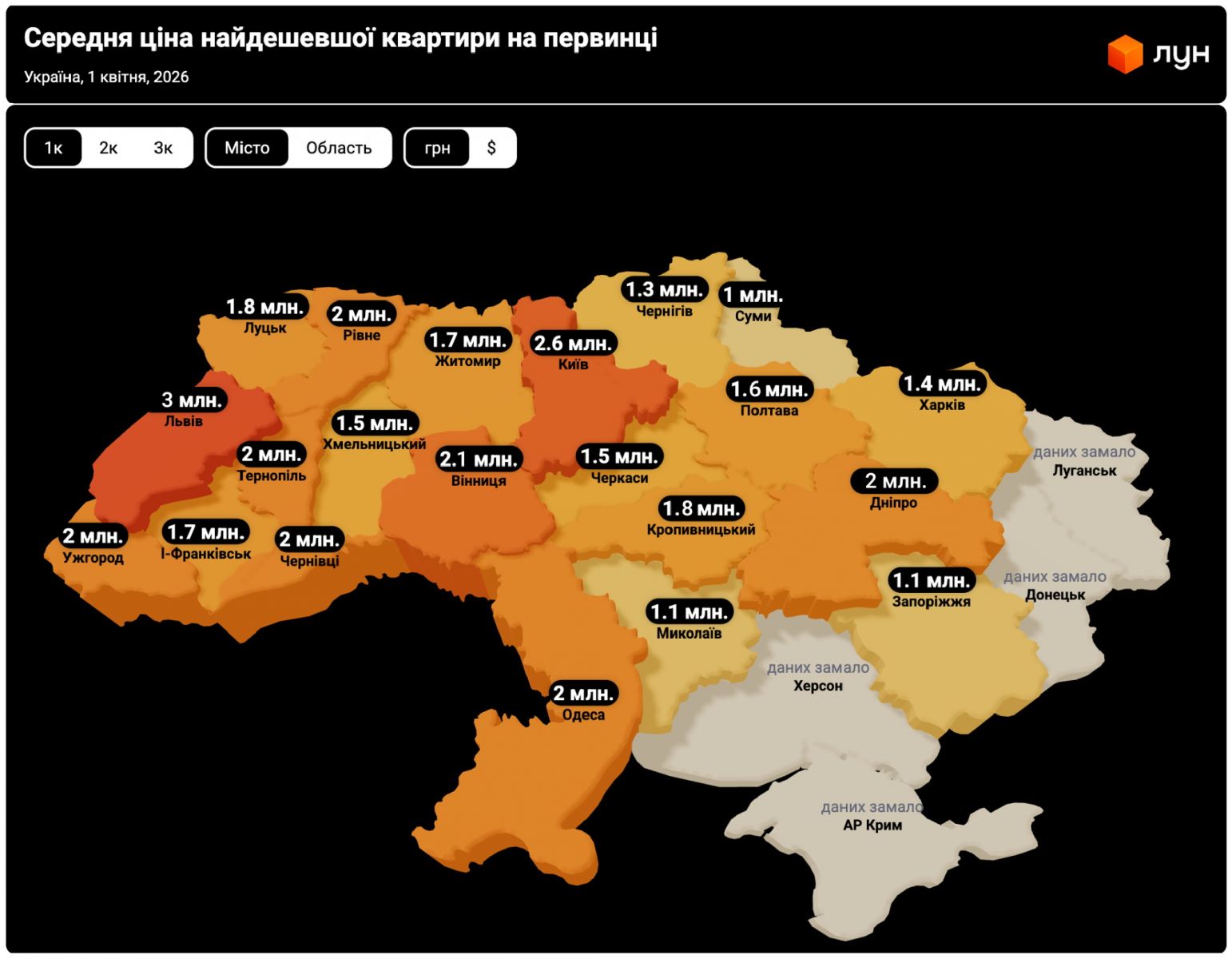
Analysts note that the volume of housing commissioned remained broadly in line with the previous year, while the number of new construction starts rose by 40%. At the same time, the number of new projects entering the market is also increasing: in Q1, sales were launched in 61 residential developments, while 59 projects were fully sold out.
Another notable trend is price growth. In most regions of the country, an increase in the average price per square metre of new-build properties has been recorded. At the same time, according to LUN, real estate investment remains attractive: on an annual basis, holding funds “in bricks and mortar” has proven more profitable than keeping them in cash foreign currency.
New-build properties in Kyiv Region, at UAH 39.2 thousand (+18%), rank only fifth, behind Volyn Region (UAH 39.8 thousand, +19%).
As for average prices by region, a significant increase has been recorded. Ivano-Frankivsk Region led the growth, with the price per square metre rising by 47% year-on-year to UAH 49,700. Zakarpattia Region ranked second, with an average of UAH 49,800 (+12% year-on-year), followed by Lviv Region, where the average price reached UAH 44,000 (+19%). New-build properties in Kyiv Region, with an average price of UAH 39,200 (+18%), rank only fifth, trailing behind Volyn Region (UAH 39,800, +19%).
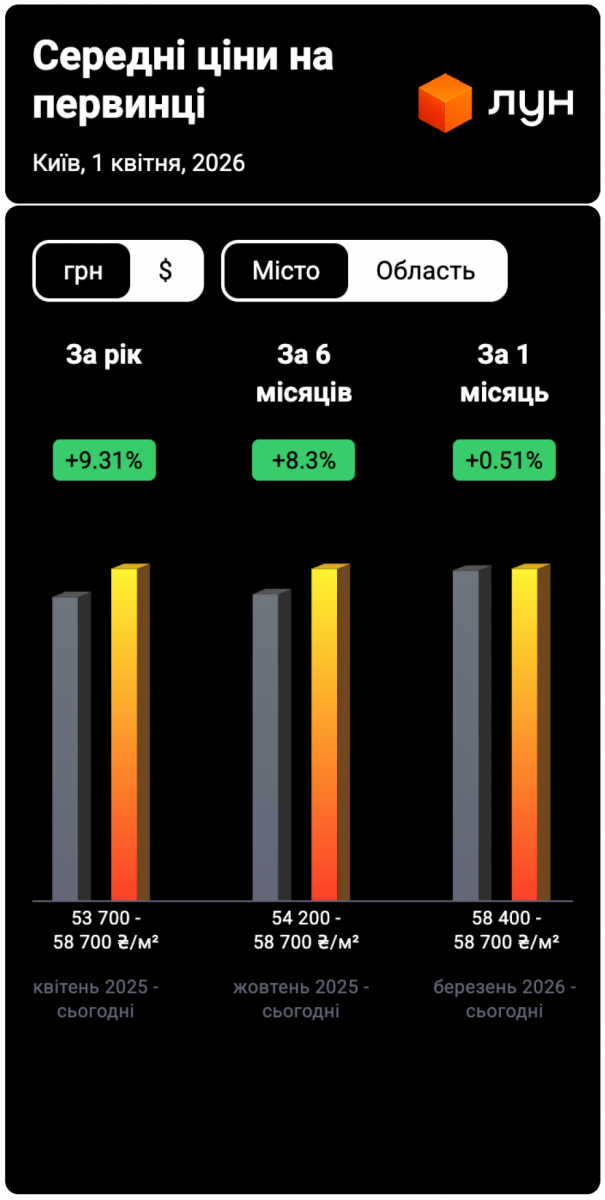
As for minimum housing prices, the highest prices for one-bedroom apartments on the primary market remain in Lviv (UAH 3 million), Kyiv (UAH 2.6 million), and Vinnytsia (UAH 2.1 million).
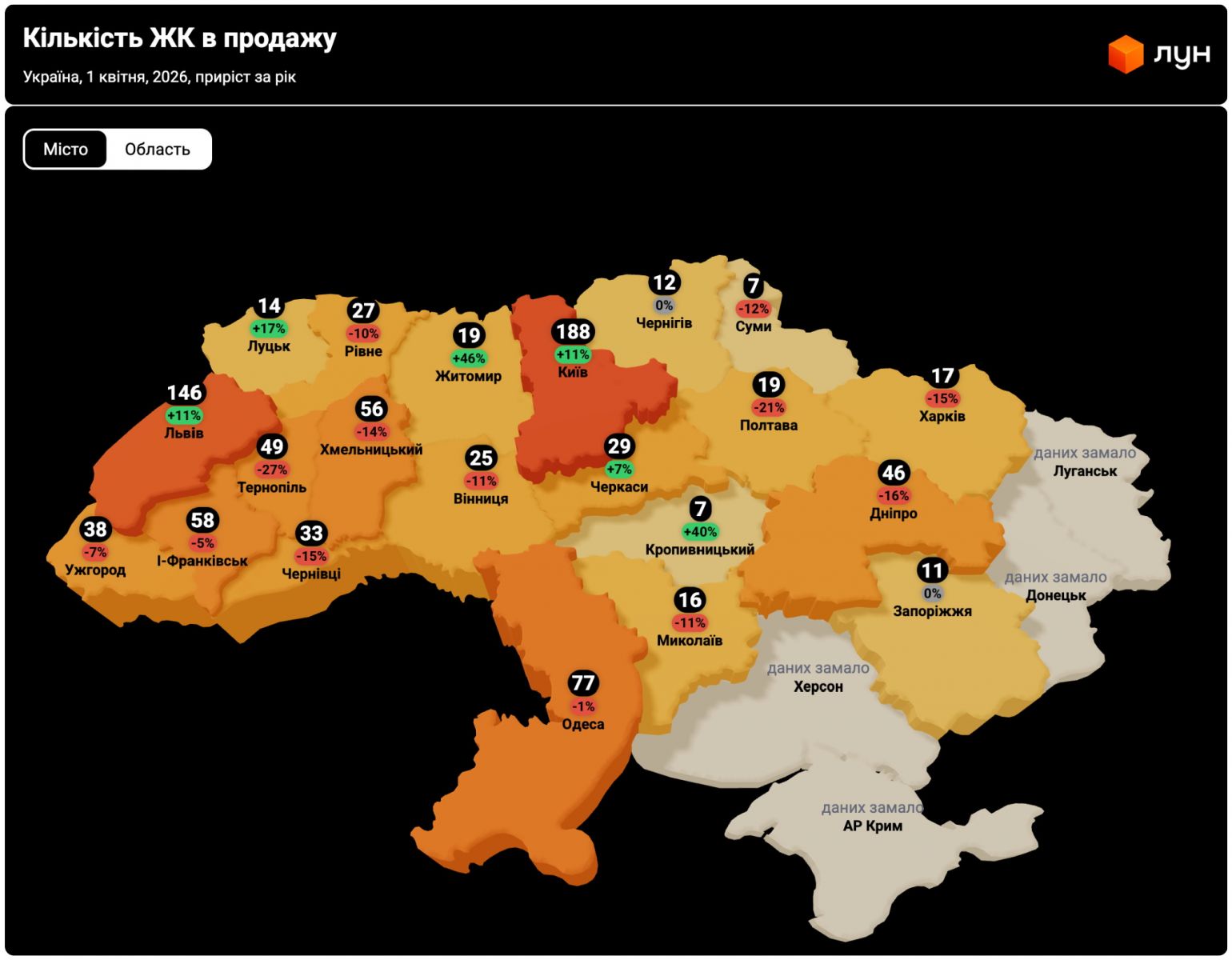
In the capital, the average price per square meter on the primary market continues to rise, with comfort-class new-build properties showing the strongest price growth. As of 1 April, 2026, the median price per square meter in Kyiv stands at UAH 58.7 thousand, up 9.3% year over year. At the same time, market segmentation is becoming more pronounced, with the price gap between properties widening depending on their class and district.
At the same time, the nature of demand itself is changing. The market is gradually shifting from choosing an individual property to choosing a comprehensive residential product with well-planned infrastructure, services, and lifestyle options.
‘Competition is no longer between individual buildings, but between entire living environments. Development is changing accordingly. The market is moving away from standalone developments toward integrated neighborhood developments with infrastructure, services, and communities. These are the projects that will shape demand and liquidity,’ said Rostyslav Melnyk, RIEL founder.
In his view, trust in the developer and access to financing remain key factors:
‘Instalment plans and mortgages have become an integral part of the product and a driver of demand. The market’s further development directly depends on access to international capital. Given the high cost of domestic financing, this is a key prerequisite for scaling up the industry,’ Rostyslav Melnyk noted.
Interestingly, the market is returning to the ‘classic’ model, with single-family homes accounting for one-third of the market.
Overall, based on the results of the first quarter, the primary housing market remains fairly active: developers are actively delivering completed apartments and launching new construction projects, while demand is becoming more selective and increasingly focused on product quality.


