

July 07, 2021
Kyiv is a city with dozens of architectural styles of different time periods from Kievan Rus to the present day. Let’s figure out in this article what the appearance of the city looks like, what historical and Art Nouveau architectural objects deserve attention.
Kyiv architectural styles
The architecture of Kyiv has been formed over the millennium through the gradual layering of various architectural styles: Ukrainian baroque, historical style, neo-Gothic, constructivism, Soviet monumental neoclassicism and neo-modernism.
Ukrainian Baroque as an architectural style has developed as a result of a combination of local traditions and European Baroque with simplification of forms and rationalization of space. This style was also called “Cossack” or “Mazepa” baroque in honour of Hetman Ivan Mazepa, a famous patron of the arts of his time. The prominent representatives of the Ukrainian Baroque are the Assumption Cathedral, Church of Nativity of the Blessed Virgin Mary, St. Nicholas Hospital Church, St. John the Tent-dweller Church, St. Sophia Cathedral, and the bell tower of the Desert-Nicholas Monastery.
The strengthening of Western European influence on the architecture of Kyiv was the arrival in the capital of the architect Gottfried Schedel, who built the Great Bell Tower, other structures in the Lavra and St. Sophia Monastery, and built on the old academic building in Podil. In 1752-1755, according to the project of Piotr Neiolov, the Klovskyi Palace was built in baroque forms, close to the architectural traditions of the first half of the 18th century. However, already starting at the late 18th century, classicism began to dominate in Kyiv city planning, which was associated with the strengthening of the Russian Empire power. Important objects in the style of classicism include the Contract House designed by William Geste, the building of Kyiv University by Vincent Beretti, as well as the building of the Institute for Noble Maidens and the Astronomical Observatory.
Since the end of the 19th century, Kyiv has been gripped by a “construction fever”, during which the monumentality of buildings was replaced by the simplicity of a rapidly growing individual estate development. The perimeter of the central quarters of Kyiv was much developed along with multi-storey apartment buildings, old streets were built up and new districts were built, such as academic quarters in Lipki area. Besides the residential buildings, factories, plants, public and commercial buildings, and theatres were built.

Historical architecture of Kyiv
Despite the dynamic development of the capital and the often negligent attitude towards historical architecture, in Kyiv, many architectural monuments remain, making up for the inner spirit and unique city appearance.
St. Vladimir's Cathedral
St. Vladimir's Cathedral is a complex architectural project that was first laid out on paper in 1852, but completed only in 1859. It took another 37 years to paint the interior and finish work. The cathedral was finally opened to the public only in 1882, and in 1896, it was presented to the Russian Emperor Nicholas II and his wife. St. Vladimir's Cathedral is crowned with seven domes, the highest of which reaches 49 meters. The interior is rich in numerous mosaics made by Venetian artists. The frescoes were created by outstanding Russian painters: Kotarbynskyi, Pimonenko, Vrubel, Kostenko, Vasnetsov and Zamyrailo under the guidance of Professor A. Prakhov. The painting “The Most Holy Theotokos”, painted by V. Vasnetsov on the altar apse, is rightfully considered a world masterpiece.

Kyiv-Pechersk Lavra
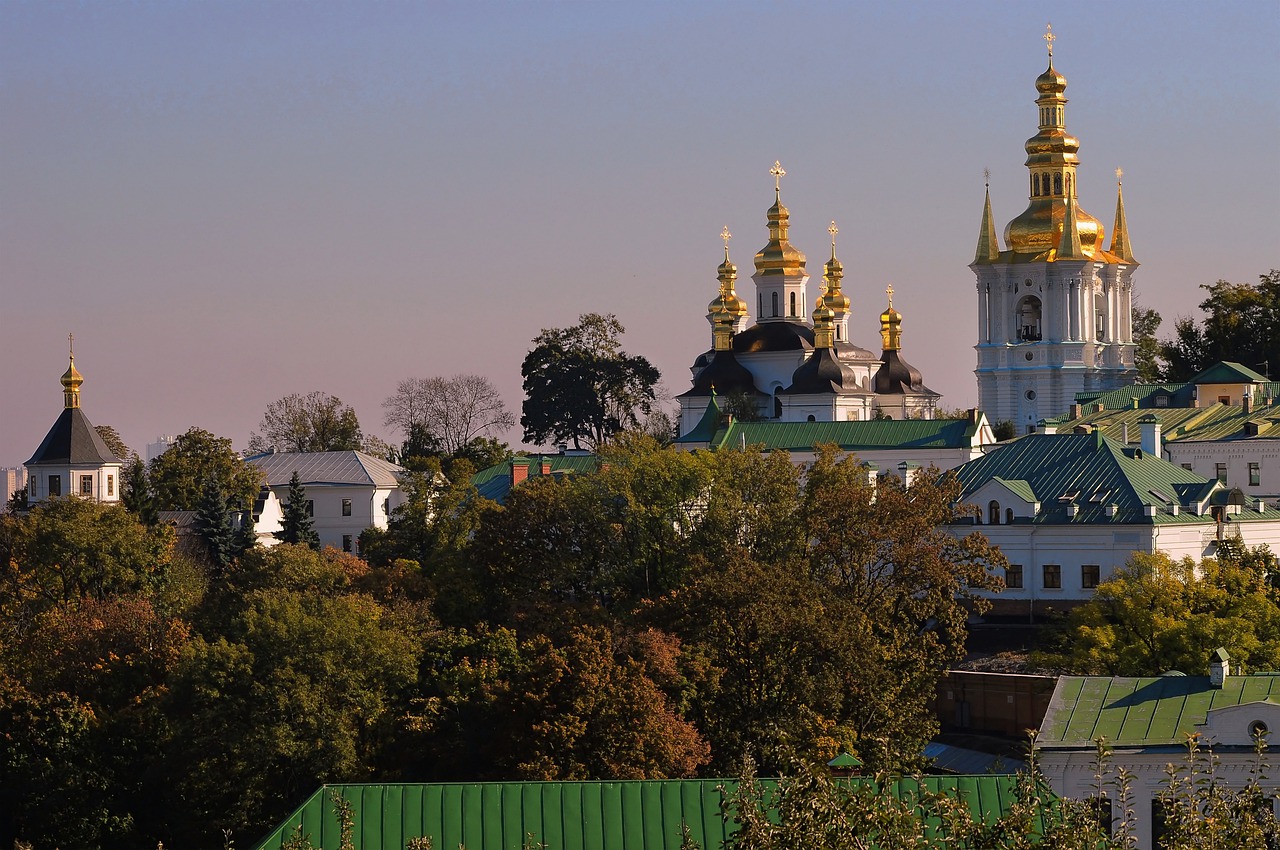
Some sources say that the Kyiv-Pechersk Lavra was founded in 1051, when the Monk Anthony arrived here. Together with some of his followers, he built a whole complex of caves and monasteries. When the monks moved to the monastery located on the Lavra territory, the caves were used for burial. At present, the object is included in the UNESCO World Heritage List.
St. Andrew's Church
St. Andrew's Church, towering over the old district of Podil from the top of Andriivskyi Hill, is one of the most magnificent works of Baroque architecture in Kyiv. It was built between 1747 and 1754 by a group of foreign and local architects led by Ivan Michurin, according to the design of Bartolomeo Rastrelli. The church was conceived as a private church for the Russian Empress Elizabeth, so there was no parish nor bells for the Mass. Due to its location on a hill, the church was erected on a two-story stylobate, which also serves as the foundation for the building. The cross-shaped St.Andrew's Church has one dome and five decorative spires.

St. Michael's Golden-Domed Cathedral and Monastery
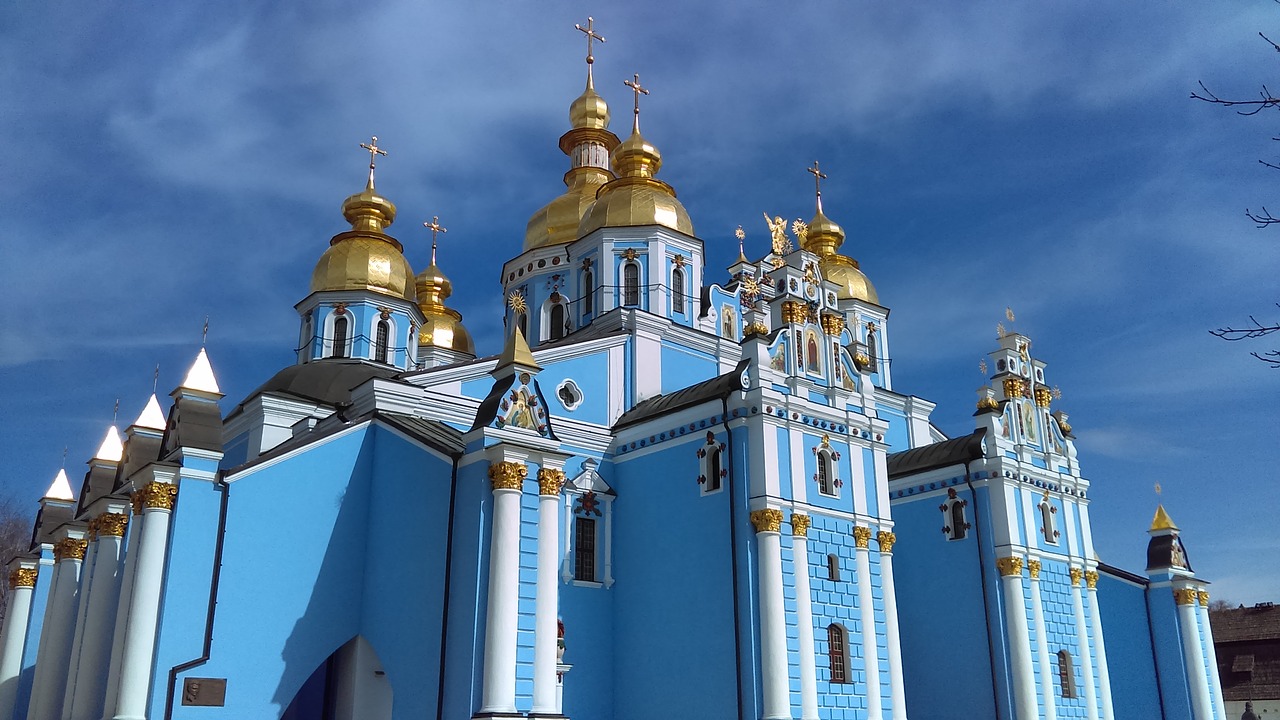
St. Michael's Golden-Domed Cathedral, one of the city's most impressive landmarks, has a rich and turbulent history. Its foundation was laid in 1108 by the sons of the Grand Duke of Kyiv Iziaslav Yaroslavych. In 1113, a Byzantine-style cathedral was opened under the auspices of the Dmytrovskyi monastery. In later centuries, a series of Mongol attacks caused enormous damage to the cathedral, so it needed renovation by the 15th century. In 1495, the cathedral was renamed as the St. Michael's Cathedral in honour of the Archangel Michael, the spiritual patron of Kyiv. During the restorations of the 18th century, the cathedral was expanded and its exterior was redesigned in the Baroque style. In 1934 the cathedral was demolished by the Soviet authorities and completely rebuilt in 1990 on the preserved original ground work. The architecture and interior decoration repeat the original.
National Philharmonic
The history of the National Philharmonic Society begins in 1863, when Kyiv branch of the Imperial Russian Musical Society was created. The House of the Merchant Assembly was built in 1881 when the local artistic community was particularly keen to provide a premise for playing classical music. By 1919, such iconic figures of music as Rakhmaninov, Sobinov, Skriabin, Nezhdanova and Shaliapin performed here. In 1919, the philharmonic society was closed, and in 1927, it moved to Kharkiv. For most of the World War II, the building was empty and only started functioning again as a philharmonic in 1944 after the liberation of the city. In 1996, after serious restoration works, the building of the National Philharmonic was opened to visitors once again.
October Palace
October Palace is a concert hall and a place where cultural events are regularly held. The palace was built at the turn of the 20th century by Vincent Beretti and originally housed the Institute for Noble Maidens (School for Noble Maidens). After the 1917 revolution, the building came over to the new government and was used as the headquarters of the Cheka (secret service of the USSR). During the World War II, the building suffered a lot of damage. The restoration lasted seven years – from 1952 to 1959 – and largely retained the original architecture. After restoration, the October Palace is used as a concert hall.
National Bank of Ukraine
The building of the National Bank of Ukraine was built according to the project of O. Kobolev, the exterior was made by Verbitskyi, and the interiors – by the famous Italian architect Elio Salia. Completed in 1905, the building boasted all modern comforts, including central heating, ventilation and electricity. The building is constructed in the Italian Renaissance style, combining elements of the North Italian Gothic and the early Renaissance of the Florentine type.
House with Chimeras
House with Chimeras is perhaps one of the most spectacular architectural sights of Kyiv. Architect Horodetskyi perceived this complex project as a one-of-a-kind opportunity to create something “non-standard”. In 1902, he presented a plan that challenged all the architectural traditions that had prevailed in Kyiv before. Constructed of concrete, the building is adorned with numerous wall ornaments and eclecticism, as well as statues both inside and out. The outside statues of dolphins, frogs, elephants, rhinos and snakes were created by Elio Sala. House with Chimeras is rarely open to the public today, but can be admired from the outside pedestrian area.

House of the weeping widow
House of the weeping widow is an Art Nouveau building constructed in 1907 according to the design of Eduard Bradtman. Recognized as a masterpiece of local architecture, the house was commissioned by Serhii Arshavskyi, who lived there until the 1917 revolution. In 1918, the house was nationalized and turned into a public institution. In 1939, the headquarters of the Kyiv military district was located here. After the World War II, the building became the seat of the Ukrainian Soviet Republican government. Since 1992, it has been consistently used by the two presidents of Ukraine as their official residence. From the outside, with its large doors, grey granite, mouldings, artificial stone blocks and labradorite, the house has retained its original appearance. In the upper part of the façade, there is a sculptural head of a woman, from which the name of the house derives from – when it rains, the water pouring down the woman's cheeks creates the illusion of a crying face.
Tenement house
The Tenement house was built in 1901 in the Gothic style. It was designed by engineer Mykola Vyshnevskyi. Baron Volodymyr Ikskul von Hildenbandt was its owner. The house was seriously damaged during the Great Patriotic War, but later repaired with the layout slightly changed, while keeping, however, its appearance actually unchanged.
Contemporary architecture of Kyiv
The modern Kyiv look is formed by residential (over 80%) and public buildings:
- administrative;
- business;
- churches;
- cultural and educational;
- sports;
- shopping and entertainment.
Residential buildings form the background of the building, and the rest of the buildings act as accents. Increasingly, as a reflection of the globalization of world architecture, buildings in the postmodern and high-tech style appear. The new buildings use modern constructive and artistic-plastic tools and materials. Among the outstanding objects of modern architecture is the building of the South Station, reconstructed by Olimpiiskyi National sports complex. Other modern buildings that deserve attention are the building of the Netherlands Embassy on Kontraktova Square (“Atelier PRO” Dutch architectural bureau) and the German Embassy on Bohdan Khmelnytskyi Street (“Martini and Grossmann”German architectural bureau). One of the most controversial structures was the building of the theater on Podil, built by the architect Oleh Drozdov in 2016. Critics have called the new building “box”, “crematorium” and “reactor tank”. However, some consider the building to be a worthy example of contemporary architecture in Kyiv, one of the few European-like buildings. Today, more and more skyscrapers are being built in Kyiv, which applies to both commercial and residential real estate.
What is the style of RIEL residential complexes
RIEL Real Estate Corporation is not limited to specific architectural styles. We are constantly experimenting with styles and solutions, we take the best from the world and European architecture, creating residential complexes that are unique for Ukraine. Here are some examples:
Nordica Residence is an elegant Scandinavian-style residential complex that embodies northern rationalism, attention to detail and comfort.
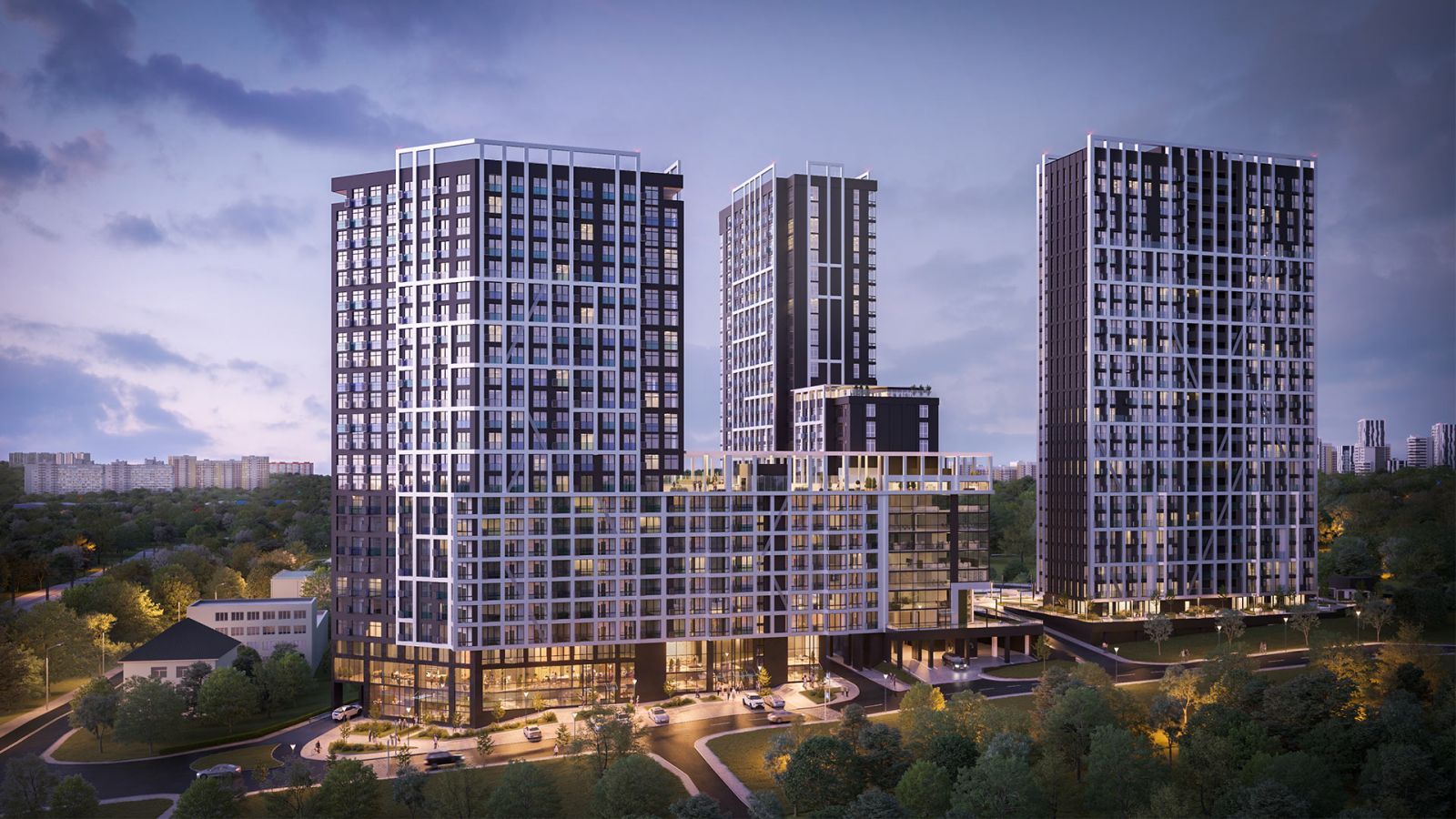
Оk'Land is a large-scale residential complex that combines simplicity and elegance of shapes with modern solutions and efficient space management.

Bereh Dnipra is a modern residential complex right on the bank of the Dnieper, which attracts attention with its sky-blue facade with bright red accents and wide panoramic windows.

Forward is a complex combining the best features of minimalism and constructivism, created for proactive citizens living in the dynamic rhythm of Kyiv.

Lvivska Ploshcha is a 15-storey elite building with a predominance of glass and light in a restrained classical style, characteristic of contemporary European architecture.

Lvivski Kvartal is a residential complex inspired by the cosy streets of Lviv and its low-rise historical quarters, where there is always a smell of delicious coffee, peace and quiet prevail.
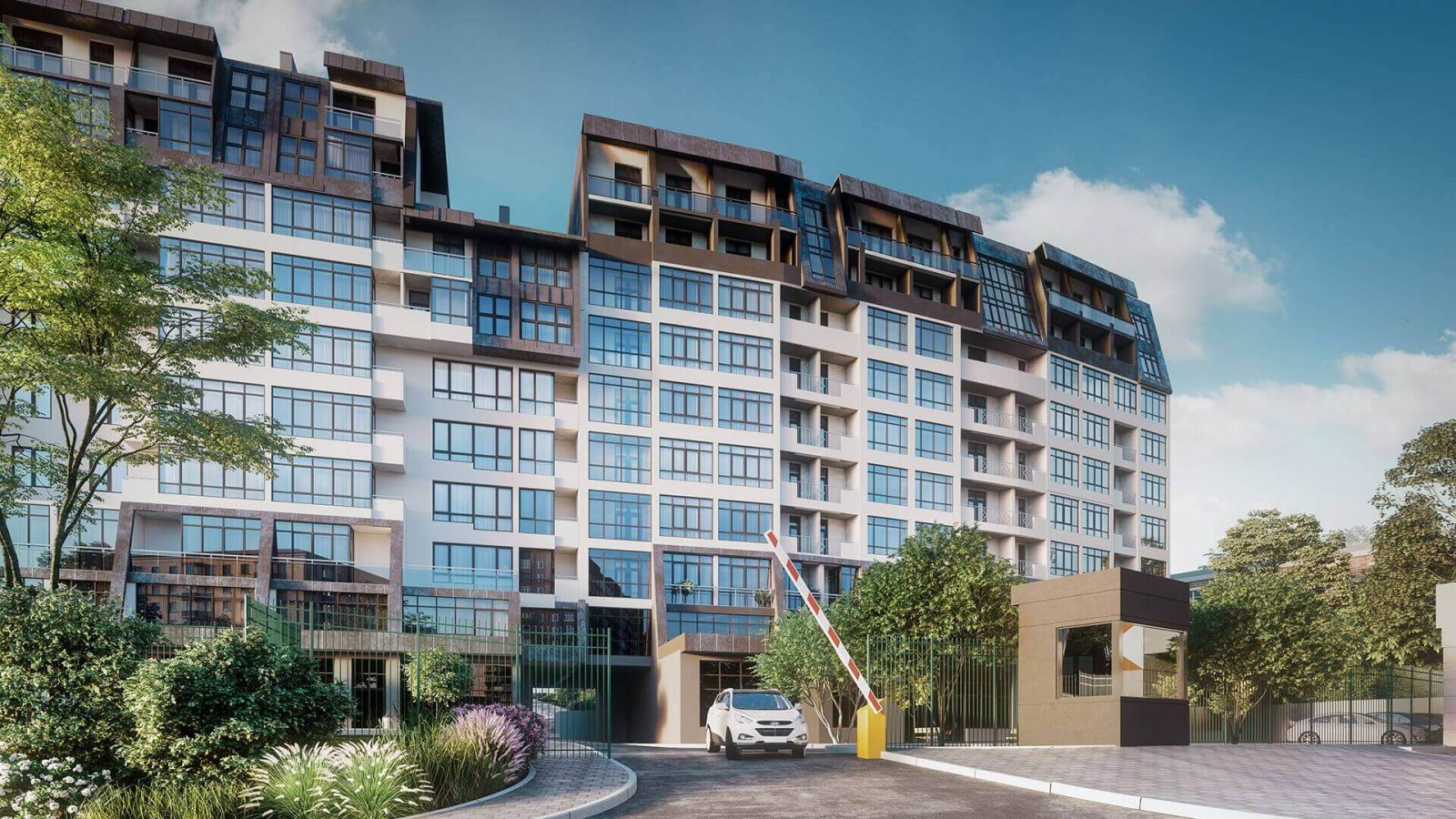
ELYSEUM is a business class house on a stylobate, with brutal forms in a classic black and white colour combination and bold practical exterior solutions.

GREAT is a complex of 13 houses with an exterior reflecting the restless waves of the Dnieper, dramatic accents and angular curves.

RIEL Real Estate Corporation projects are bold contemporary solutions for a comfortable and safe life in the best districts of Kyiv. To find out more about our residential complexes, call us or leave a request for a call back on the website – we’ll call you back and help you to choose the appropriate option.
Faq
- Which architectural styles can you find in Kyiv?
- What are some examples of Classicism in Kyiv's architecture?
- What defines Classicism in buildings?
- Which historic buildings in Kyiv are worth seeing?
- Where has old architecture survived in Kyiv?
- How does architecture affect the choice of housing in Kyiv?


